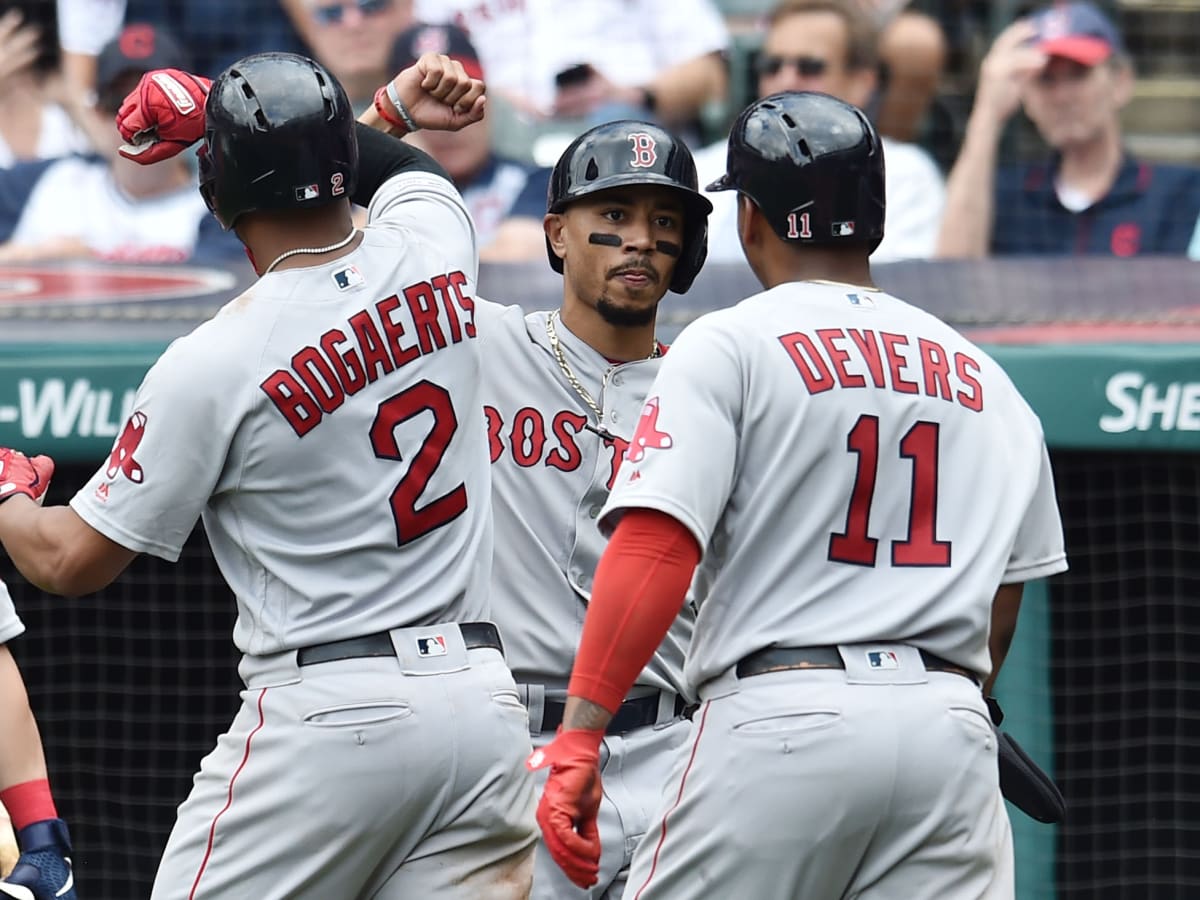
Xander Bogaerts is a San Diego Padre. What a strange sentence to write. But it’s true, all 11 years and $280 million of it. The Red Sox played a dangerous game of chicken for months, and this is the end result: San Diego swooped in with a buzzer beating blockbuster in the final moments of the Winter Meetings, Bogaerts is heading west for the next decade-plus, a day with two substantial Red Sox moves (signing All-Star closer Kenley Jansen and NPB star outfielder Masataka Yoshida) ended more bitter than sweet, and Red Sox Twitter self-immolated spectacularly in a way that only Sox fans scorned can. The reasonable take? Boston could have nipped this all in the bud last winter with a competitive offer. They didn’t, and opened the door for some team–in this case an all-jacked-up-on-Mountain-Dew AJ Preller and his Padres–to throw all of the money and years at Bogaerts and take things to a point where no sane person would be willing to go. Having said that, every sane person would agree that the Red Sox are a worse team today without Xander Bogaerts, and the Padres are a better team. The Red Sox, a team already in search of an identity, just lost a franchise cornerstone and incredible leadership figure. In many ways, it’s almost impossible to assign value to that.
But we don’t live in a time of reasonable takes, so naturally the pitchforks are out. Boston’s offer of 6 years, $160 million was well off the Padres’ pace, although not far off Bogaerts’ projected contract:
The Padres clearly blew everyone out of the water here. That’s the inherent danger of free agency. The Red Sox cobbled together their own coffin on this with their ludicrous, Lester-esque 4 years, $90 million non-extension offer before the season, then followed that up spending the last couple of months claiming Bogaerts was their top priority this offseason. They set themselves up for this exact scenario, and it should never have gotten to this point. I am more dubious than others that the 6 year/$160 million offer would have gotten the job done in February, but at minimum it would have been a better starting place (or merely a starting place) to negotiate from. What’s frustrating to me, and many others, is that this isn’t the first time that this ownership group—and to be clear, organizational decisions about franchise pillars like this are ownership’s call, not the front office—has failed to retain key players who have proven they can thrive in Boston’s intense market in favor of outside talent. The main prior examples there are Jon Lester and Mookie Betts, two situations were handled so egregiously that they, along with how Xander Bogaerts left, are going to cast a pall over the organization for a while. Bogaerts was every bit the cornerstone everyone hoped he would become when he was first called up in 2013. Meeting expectations like that is rare, and letting a player of his stature walk away with no real replacement in place is going to have tremendous ramifications. Even if I can’t blame the Sox for not matching the Padres kitchen-sink offer, and am happy for Bogaerts that he’s set for life and going somewhere where he’s (apparently) actually wanted, it’s hard not to be upset that this wasn’t handled differently.
I’m sure plenty think that Red Sox fans are acting like spoiled brats, ready to run the same ownership group out of town that ended an 86-year championship drought, then added another three World Series titles for good measure. They’re not wrong to think that necessarily, although I’d offer this caveat: status in sports is not static. Just because your team is good now doesn’t mean that they’re going to continue to be good for eternity. Recent success doesn’t mean fans are barred from rooting for that team to continue to put itself in position to win again. If fans no longer hold their teams accountable and no longer root for the team to win, or for their favorite players to succeed wearing that team’s colors, then what’s the point of all of this? Sure, the Red Sox had maybe their best season ever in 2018, but as we’re seeing now things can change dramatically in a few short years, and winning championships are far from guaranteed.
To that effect, here’s a cautionary tale: In November of 1916, the Red Sox were coming off their second straight World Series victory, and their fourth win in 14 years. That month, theater producer Harry Frazee bought the Sox from then-owner Joseph Lannin. The Red Sox won 90 games in 1917, then won another World Series in 1918. Boston was the hub of the baseball universe. It had Babe Ruth, the best player in the game. 1919’s title defense sputtered, and Frazee (thanks to a multitude of economic factors stemming from World War I) was having difficulty maintaining both his baseball and theater businesses. In order to stay afloat, Frazee started pawning off his star baseball players including, most famously, Ruth.

I won’t tread too heavily on this well-worn path much. If you’ve made it this far through this (hopefully) semi-coherent ramble, you likely know the rest of the story: Frazee sold Ruth to the New York Yankees for $125,000 on January 5th, 1920 and the Curse of the Bambino was born. The Yankees went on to win 26 World Series titles in the 86 years before the Red Sox would finally win again in 2004. New Englanders were born and died for decades without ever seeing the Sox hoist a World Series trophy.
But as bad as selling off Ruth was, it was merely part of the story. Just as importantly, it wasn’t only Ruth that Frazee cashed in on. Over the next few seasons he would sell or trade a bunch of key Sox contributors to the Yankees, like future Hall of Fame pitcher Waite Hoyt, infielders Everett Scott and Joe Duggan, catcher Wally Schang, and pitcher “Bullet” Joe Bush (who won a career high 26 games in his first season in New York in 1922). Frazee even offloaded Hall of Fame outfielder and cornerstone of those 1910s Sox teams, Harry Hooper, in March 1920, dealing him to the White Sox despite claiming “I’m willing to trade any man on my team, excepting only Harry Hooper” a few months prior. The Red Sox followed up this fire-sale with a long tenure under notorious racist Tom Yawkey, whose unwillingness to be a decent human being meant the Red Sox were the last team to integrate, and effectively turned away players like Jackie Robinson and Willie Mays.
In that way, the Curse of the Bambino was always misnamed. It wasn’t a shadow with Babe Ruth’s face that stabbed Boston’s championship hopes in the chest every year, and it wasn’t that sale alone that caused the Red Sox to devolve into an American League bottom feeder for the entire 1920s and most of the 1930s. It was a series of moves and non-moves, sometimes coming as an avalanche, sometimes not coming to light until years later, fueled by top-down incompetence for decades upon decades that left the Red Sox seemingly always one play or one player away. Until, ironically, a group headed by John Henry, Tom Werner, and Larry Lucchino bought the team in 2001, put the right people in place, and changed the the franchise’s trajectory. If anything, it’d probably be more apt to call it “The Curse of Frazee” or “The Curse of Yawkey” or “How Fail in Multiple Businesses Without Really Trying“.
If you need any proof that history tends to repeat itself, look no further than Boston’s current state of affairs: Since winning their fourth World Series in 15 years in 2018, they’ve played the following greatest hits from the Curse playbook:
- Disappointing title defense in 2019
- Trade best player on team (Mookie Betts) for relative pennies (apologies to Alex Verdugo, Jeter Downs, and Connor Wong), just over 100 years to the day of the Ruth sale
- Lose/trade other key members from that championship core (Bogaerts, Andrew Benintendi, Jackie Bradley Jr., Christian Vazquez, JD Martinez, Nathan Eovaldi are all no longer on the team, without meaningful upgrades at any of their positions)
- Last place finishes in 2020 and 2022
- An ownership group in Fenway Sports Group currently with interests diverted elsewhere and, if the Liverpool sale is any indication, looking to consolidate funds
It’s a reboot with a script so familiar that it’d make J.J. Abrams blush. Granted, times are different, and while the Red Sox are at a crossroads I like to think that they have the resources and proper baseball-minded people staffed to ensure the right moves happen. As upsetting and frustrating as Bogaerts’ departure is, I can’t call it the straw that breaks the Green Monster’s back. As I wrote back in October, there were real, defendable baseball reasons to not break the bank for Bogaerts. But if the Red Sox don’t replace him, and if extension talks with Rafael Devers continue to stall, things could get bleak very quickly. Just look at the Red Sox wRC+ ranks by position since 2019:
| Position | wRC+ Since 2019 | MLB Rank |
|---|---|---|
| C | 92 | 14th |
| 1B | 96 | 25th |
| 2B | 84 | 23rd |
| 3B | 130 | 1st |
| SS | 125 | 1st |
| OF | 103 | 11th |
| DH | 122 | 5th |
It’s pretty clear that the Sox have been carried offensively by Bogaerts, Martinez, and Devers over the last few seasons. Bogaerts is already gone, Martinez is unlikely to return, and Devers could be traded before Opening Day if the Red Sox are unwilling to commit to yet another homegrown star. That’s obviously a Code Red, nuclear scenario that would also almost certainly result in another last place finish, Chaim Bloom scapegoated, and FSG moving on to other ventures. It doesn’t seem possible that things could sour so quickly after such an incredible 2018 season. And yet, here we are, about to cross the Rubicon during the most pivotal Red Sox offseason since 2003.
Is it melodramatic to say we’re entering the early stages of another long championship drought? Almost definitely. But then again, Harry Frazee was never going to trade Harry Hooper. Even when he did, I doubt fans of that day thought it’d be nearly 90 years before the Sox would win again. And if Rafael Devers is indeed dealt in the next 6-8 months, well we best start believing in curses again Red Sox fans, because we might be in another one.
 For The Love
2 replies on “The Curse of FSG”
[…] full-on fib, perhaps exaggeration is a better description? Granted this space has been prone to the occasional melodramatic post so that shouldn’t be too surprising, but I still feel like I should come […]
LikeLike
[…] Xander Bogaerts signed with the Padres in December 20229, I wrote about how the infamous Curse of the Bambino wasn’t really a curse at all. It was decades of […]
LikeLike