Let’s talk about a revolution.
In 2023, Christopher Clark put out an incredible survey of the revolutions that gripped Europe in 1848. This has always been a bit of a blind spot for me, slotted right in the middle of the two pillars of modern European history: the French Revolution and the World Wars. And while a sprawling history of the social and political upheavals that rocked villages and metropoles from Dublin to Bucharest over the span of two years has a lot of opportunities to be a disorienting snooze-fest, Clark manages to wrangle together the disparate strands of this international moment and create an immersive look at how 1848 played out.
For Clark, 1848 is the key to understanding those other more notable moments in European history. It’s only in the revolutionary moment of 1848 that the idealistic pronouncements of the French Revolution were made manifest, all while laying the framework for the creation, destruction, and rebirth of Europe in the early 20th century. Widespread political engagement, universal male suffrage, actually representative parliaments, constitutions, freedom of the press, freedom of religion, engagement of the state in addressing economic and social problems: all of these essential pieces of modern political systems sprang out of the tumult of 1848.
As a stepping stone to the modern, 1848 is also notable for the real-time feedback loop of mass-communication and the spectacle of revolution. Clark points out the international scope of these revolutions was fueled by newspapers, broadsides, pamphlets, and etchings. The dashing revolutionary style of Friedrich Hecker (check the drip), the romantic patriotism of Robert Blum (poor guy), the eclectic mix of workers and liberals vying for power on the streets of Paris – these images and archetypes were spread far and wide even as events were unfolding across the continent.
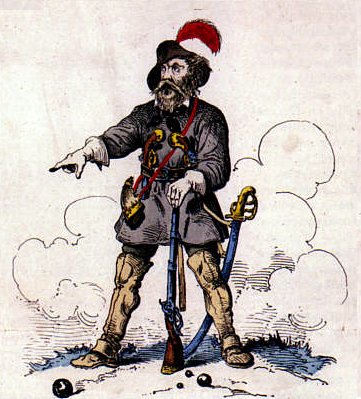
Aesthetical considerations permeated all levels of revolutionary activities. Radical Hungarians fighting to independence donned traditional garb, the Frankfurt Parliament that met to address the demands of German liberals came together in a grand cathedral festooned in the German tricolor and a statue of Victoria, and French revolutionaries donned the Phrygian cap and sang “le Marseille.” Choices in styles of dress, language, place of meeting, and music all were steeped in subtext: which side are you on?
So as we find ourselves on the verge of another moment of international crisis, where performativity and signifiers are intensifying the partisan divide, I thought it would be helpful to take this framework into one of the culture wars’ most hotly contested battlegrounds: the Oscars.
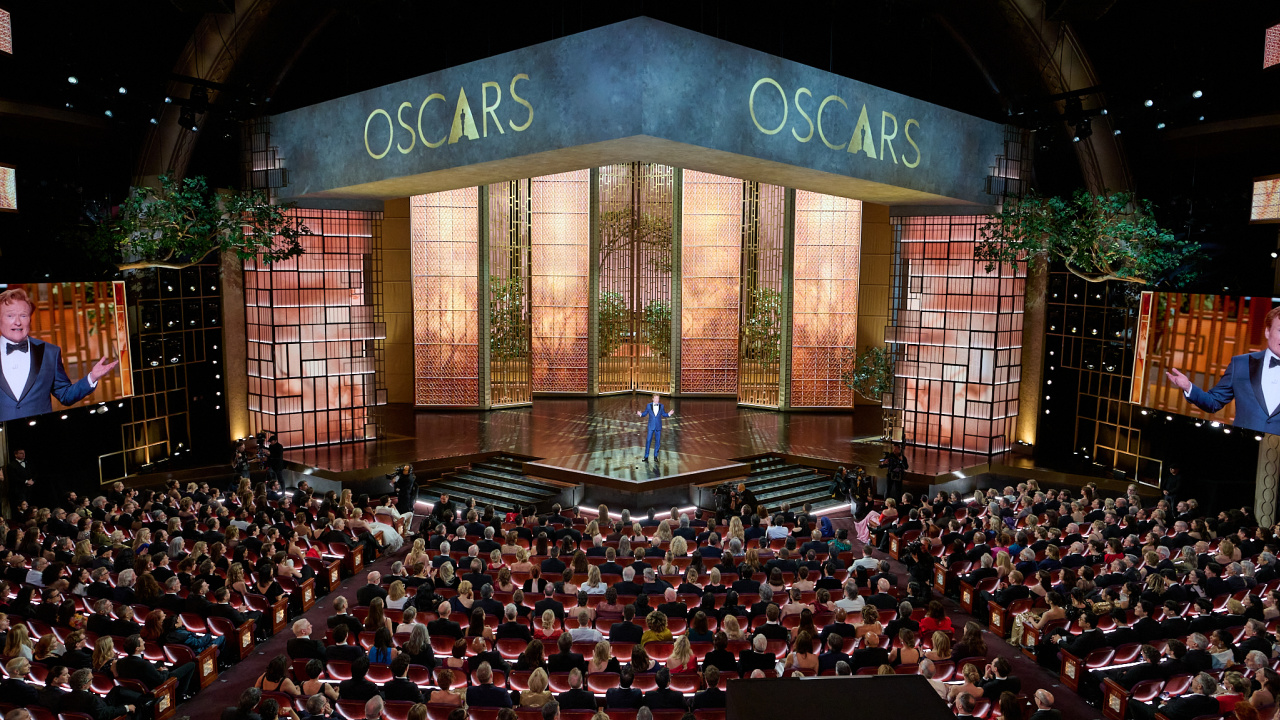
prove me wrong!
Yes, while the 98th Academy Awards have come and gone, I am still thinking about these films. Because, as Paul Thomas Anderson so graciously pointed out as he accepted the award for Best Picture, this year – like some notable others – was absolutely stacked (Barry Lyndon got robbed and I will die on that hill).
My diversion back to 1848 was only partly onanistic – I will always tell you about the book I am reading whether you want to hear it or not – but I do think the connection holds. Both One Battle After Another and Bugonia are in conversation with the idea of revolution and aesthetic.
In One Battle After Another, revolution serves as a lens through which we are to understand the central struggle of the film, which is the relationship between Leo DiCaprio as Bob and his daughter Willa, played by Chase Infiniti. The first third of the film focuses on the ill-fated romance between Bob and Perfidia Beverly Hills, played by Teyana Taylor. Revolutionary activity brings Bob and Perfidia together and undergirds their relationship. Anderson is fairly explicit in his framing here: the montage of Bob and Perfidia courting each other is interspersed with bomb-making lessons, explosions, and trying to hook up while actively blowing up a government radio tower.
The aesthetics of revolution also frames their actions as things start to go sideways: Perfidia’s idealism drives a wedge between her and Bob as he tries to settle them into a normative family life; Perfidia must make a choice to stay loyal to the cause or betray her comrades; and Bob’s spiral into burnt-out conspiratorialism sets up the second half of the film. The rest of the film grapples with the consequences of the actions taken by these characters during the romantic highs of their French 75 glory days, even as that flaming passion has long since died out.
The revolution serves the heighten the tensions and provide stark contrasts to an intimate family drama. Not to sound crass, but Anderson here is pulling what I lovingly refer to as the George Lucas approach: grafting a tender and complicated story of family members navigating trauma onto a world-historical event with lots of explosions.

And that’s fine. I really like One Battle After Another. And, no shade to George Lucas, but Star Wars is also pretty good. But if we have learned anything from the recent explosion of Star Wars media in the past few years, it is that the George Lucas approach really only works in isolation. Star Wars IV: A New Hope was awesome when I first saw it, and it will always hold a special place in my heart. But, in all seriousness, it is absolute dog water compared to Andor. Two seasons following around Cassian Andor take us away from the soapy melodrama of a family of space wizards and into the gritty, relatable universe of a mostly regular guy trying to prevent the spread of fascism. Andor is so gripping because the stakes are so brutally understandable: a low-level security officer with a gun is scary, a stodgy middle-manager with a bad attitude can ruin your life, and power hungry bureaucrats that you never see are trying to destroy our society.
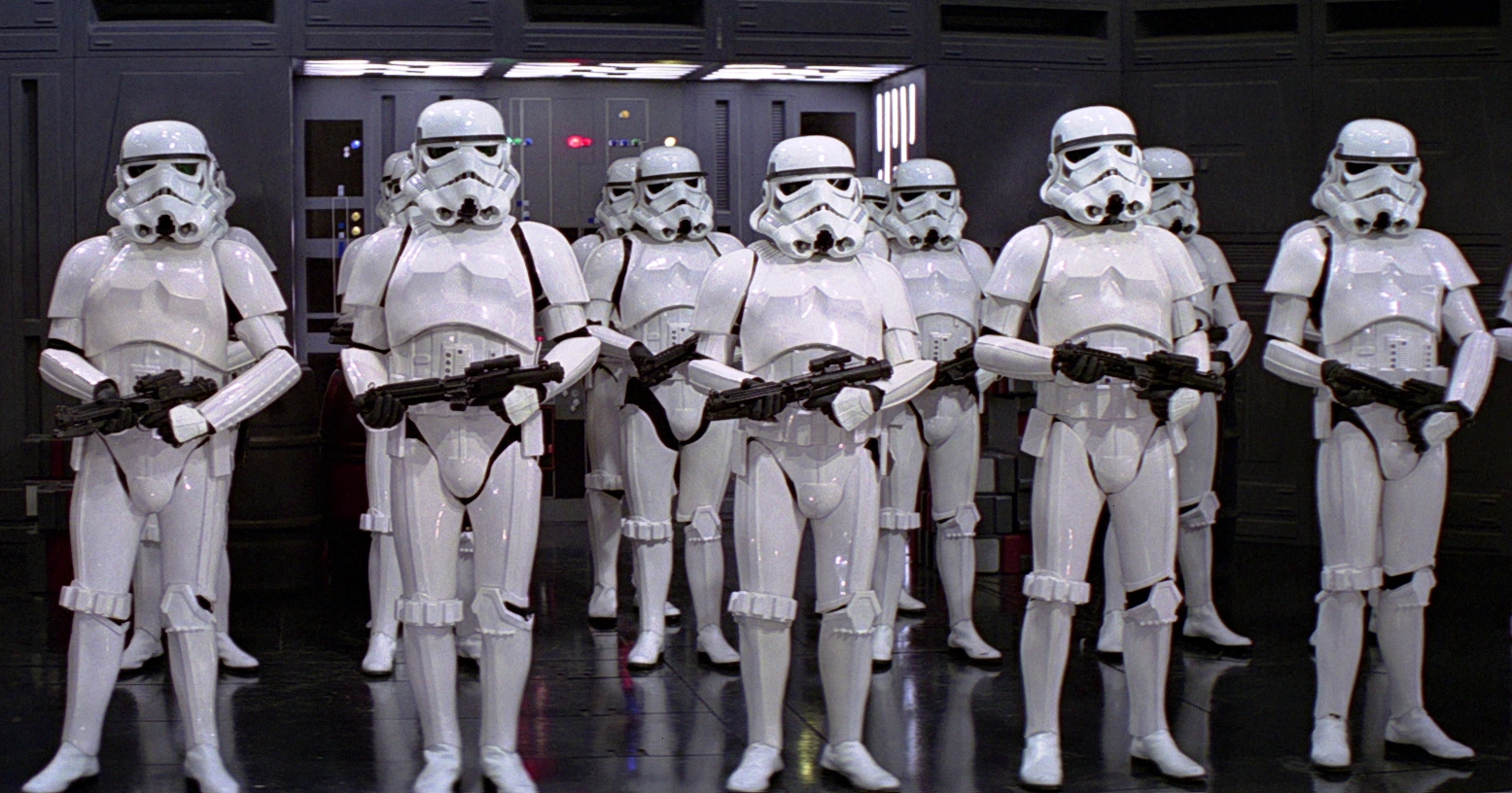
And these societal struggles can’t just be resolved by some whiny yokel brat showing up one day, killing his dad, and leaving. Andor brings us into the endlessly fascinating sites where revolutionary resistance is actually happening, providing a much more satisfying and gripping narrative than the family drama of the original trilogy could ever provide.
So this is where we have to talk about Benicio del Toro. Wittingly or not, Anderson gives us the same look under the hood as Andor through the character of Sergio St. Carlos (and as incredible as that name is, I’m just going to call him Benicio del Toro, that’s who he is, that’s what you said in your head every time he popped up on screen). As Bob’s old battles come back to haunt him, he seeks help from Benicio del Toro, the sensei to his daughter Willa. As del Toro helps out a stumbling Bob, we see that he is secretly running an operation to support migrants within his community, providing direct support, housing, and food to those most vulnerable to the authoritarian crackdown instigated to find Bob and Willa. Del Toro’s work to support a hapless Bob is just a small part of the broader work he is actually doing to fight back.
By putting del Toro here, we don’t just have a calm, cool, and collected foil to the frenetic Bob. Del Toro’s existence deflates the revolutionary bonafides of a character like Bob, despite Bob still being revered for his former work with the French 75. Just as watching Caspian Andor and Luthen Rael manage a secret operation for years makes Luke and Han feel not only flat but insignificant, knowing that Benicio del Toro has been out there grinding for decades really puts into perspective how much of a nonfactor Bob is in the broader tapestry of this universe. Planting a few bombs 20 years ago is literally the least you could do. Without the love triangle of Sean Penn (also in this movie!) Bob and Perfidia, who the hell even cares about Bob?
And yes, I get it, this is a weak line of argumentation – if this movie was about something different, it would be a different movie, duh. But all of this is to say that the interplay between Bob and Benicio del Toro underscores how revolution serves more as context rather than text in this film. It is there to underscore the emotional drama at the real heart of the action, a backdrop to provide some cool explosions and some heightened stakes, but, even despite the hubbub by critics across the center and right, there is really nothing revolutionary here.
But, if One Battle After Another has an aesthetic fascination with revolution, using it to heighten the stakes of the personal conflicts at the center of the film, another Best Picture nominee flips this logic on its head. In Bugonia, Yorgos Lanthimos plays with revolution and aesthetics to disorient the audience, toying with our sense of perspective. There are spoilers here for Bugonia, so, if you have not watched it yet, go do that now. I’ll wait.
Good, right?
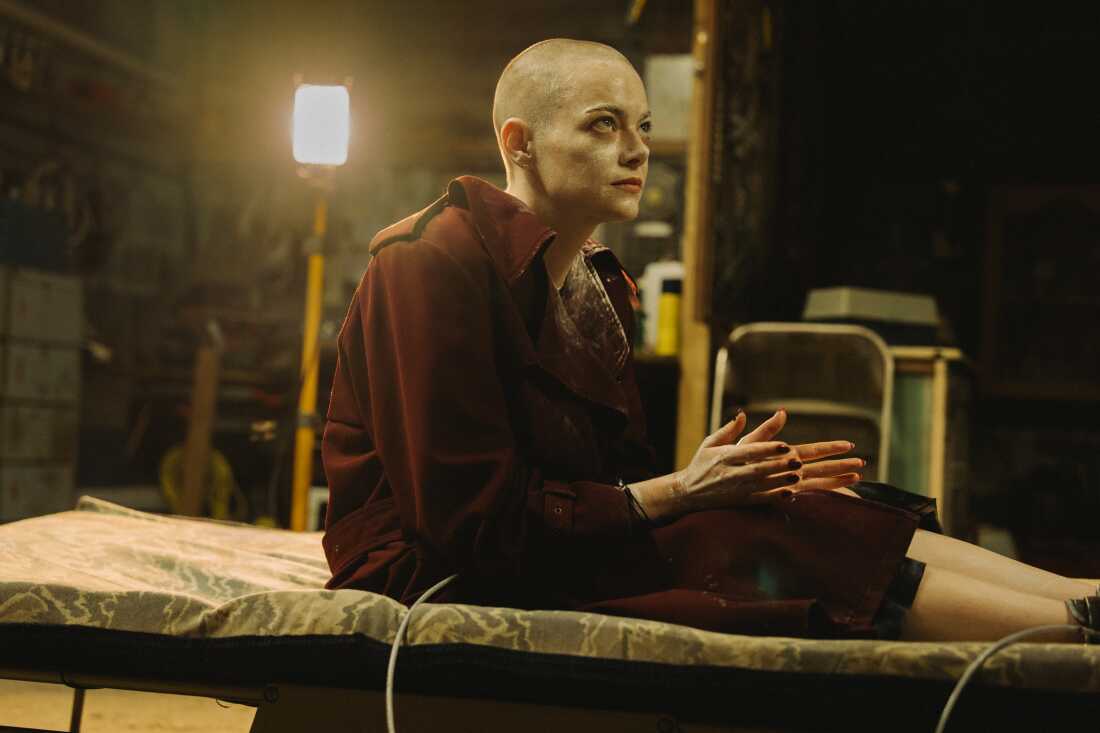
Bugonia offers us two clear archetypes: Emma Stone as Michelle Fuller and Jessie Plemons as Teddy Gatz.
Michelle is the girl-boss She-EO of the pharmaceutical conglomerate Auxolith. Although a touch prickly and unable to really connect with her underlings, she is wealthy, driven, and deeply image-conscious: an amalgamation of all the worst people you’ve seen on LinkedIn rolled into a biting caricature of C-suite achievement.
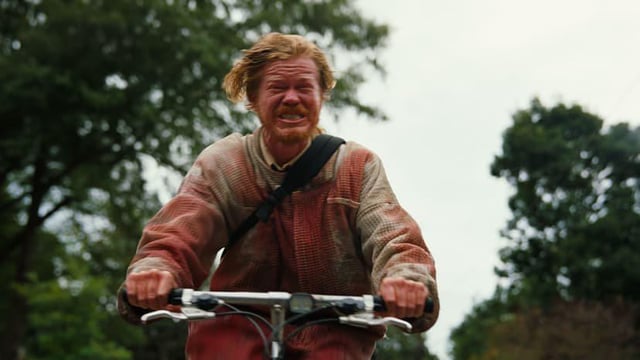
She contrasts starkly with Teddy. In Teddy, we have a figure that has been getting more and more attention recently. A conspiratorial, neck-bearded, basement dweller, Teddy is the punchline and boogeyman of American masculinity. He’s poor, he’s uneducated, he’s isolated, and he’s a lifelong victim of forces both big and small (Stavros is a brutal character in the best way possible). He’s also unkempt, sweaty, and poorly dressed.
The aesthetic contrasts between Michelle and Teddy are glaring, and this redounds to their characterization in the film. Michelle, even while in chains, exudes a sense of authority and control. Despite her cold demeanor, we can easily sympathize with her. Even as we learn about the devastation her company has caused, she is able to rationalize everything, if not for Teddy, at least for the audience. She is relentlessly on message and manages to control the narrative (or dialogue).
Teddy, meanwhile, is a mess. As Michelle continues to outmaneuver him, he grows frustrated and starts spouting increasingly deranged and violent threats. He’s unable to confront his own anger and shame at the loss that Michelle has caused as he desperately flails to control something, anything, even as it all comes crumbling down. While we see genuine care and concern for his cousin Don, his all-consuming conspiratorialism leads to abusive behavior. What little pity we may have had for this tragic character evaporates when Michelle finds the chilling truth that she is not his first victim.
All this is a bit too on the nose, confirming our worst fears about the gross denizens of the internet’s underbelly: the dirty and dumb conspiracists are not just woefully misinformed, but actual criminals! But, in a wild and wonderful sequence, this is all upturned by the revelation that Michelle is, in fact, an alien, and that Teddy can go to meet with the Andromedans to try to save humanity. Teddy is unfortunately killed and the fate of earth is sealed.

So, what are we to make of this? I’m glad that Lanthimos had the courage to play this out in full, as the bizarre reversal gives us a new perspective on Michelle and Teddy. Michelle really is an alien who ultimately destroys earth, and Teddy, while still a mess, is a vindicated freedom fighter who is humanity’s only hope. By breaking with our expectations, Lanthimos forces the audience to sit in the tension created by this move and has us reflect on the implications for Teddy.
Thinking back on the film, why is it easy to still sympathize with Michelle, even though, in the universe of the film, the enormity of her crimes as a pharmaceutical CEO and as an all-powerful alien monarch dwarfs anything that Teddy could do in his basement. Why is it, even watching the film again with the full knowledge that Teddy is mostly right, is his pursuit of an unambiguous good so off-putting? Are we so easily swayed by looks and vibes that we can be fooled about who the good guys are?
There’s a great scene from the 2008 HBO series John Adams (shout out my dawg Paul Giamati) that encapsulates this tension. John, a moderate, is talking to his cousin Sam (no, not that Sam) about the state of British overreach in Boston. Sam, along with John Hancock, helps drum up the crowd of disgruntled longshoremen, who eventually tar and feather the British customs collector. The scene is vivid in its depiction of this truly sickening form of torture. John can only look on in helpless terror, underscoring the depravity of the men caught up in the ghastly business.
Yet, despite John’s disgust, these are his fellow revolutionaries. John advocates on their behalf at the Continental Congress in Philadelphia, drums up support for the war effort, and struggles to secure arms and munitions for them. And while in real life these events may be temporally dislocated, in the narrative of the show, and in the popular historical imagination, they are virtually contemporaneous: tarring and feathering, Lexington and Concord, and the Declaration of Independence sit side by side in the history books. The barbarism of vigilante justice and the high-minded idealism of our founding document are inextricably linked, no matter how distasteful that may be.
The revolutionary spring of 1848 climaxed when disparate social forces all pushed together towards a common goal. Peasants in the fields chaffing under unbearable feudal tenures, workers in the cities facing Dickensian conditions of poverty, and a burgeoning class of liberal artisans, clerks, academics, journalists, and lawyers pushing upwards against the tightly-guarded political power of the Ancien Regime: all of these groups, despite their differences, took it upon themselves to build a better future.
After the barricades and the capitulation of monarchs, these factions had to find a way to reconstitute a political system. But, unresolved tensions between these groups led to fragile new governments. Bourgeois liberals wanted access to the levers of power, but were wary of using this power to address social and economic concerns, especially if these moves would in any way jeopardize their wealth and property. Workers and peasants, sensing betrayal, railed against these new institutions. Students and journalists, now deputized by the newly minted governments, use the power of the state to crush industrial organizing and peasant movements. As Clark puts it, the top hats and waist coats simply would not abide the work smocks in the halls of power. This internecine backbiting created unmanageable instability, opening up the whole enterprise to the forces of counterrevolution.
As we experience our own moment of structural instability, Bugonia offers a valuable insight into the aesthetics of revolution. Appearances can be deceiving. When everything is at stake, it’s important to remember who is helping push forward to together, and who is pushing everyone apart. The well-dressed, respectable people trying to get us into a dialogue may not really be interested in listening to us at all. Alright, let’s go to work. .


